
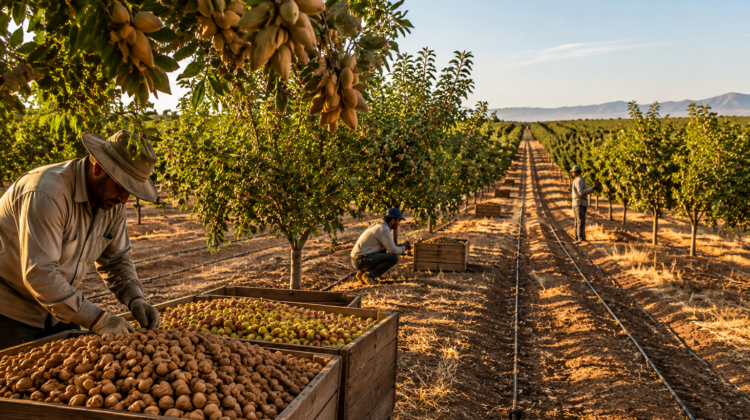
Understanding Sustainable Farming Practices in Food Trade
Sustainable farming practices aim to produce food while protecting the natural resources, agricultural systems and communities that support long-term production.
For nuts, dates, dry fruits and other food ingredients, sustainability begins well before packing or international shipment. It can involve soil management, water use, crop protection, biodiversity, harvesting, worker welfare, traceability and responsible post-harvest handling.
However, the word “sustainable” should not be used as a vague marketing claim. Buyers need clear information about the practices behind a product and the evidence available to support environmental or social claims.
This guide explains the main principles of sustainable farming, how they connect with food trade and which questions buyers should ask when discussing responsible sourcing.
What Are Sustainable Farming Practices?
Sustainable farming practices are agricultural methods designed to support food production while reducing unnecessary pressure on natural resources.
These practices may focus on:
- Protecting soil health
- Managing water responsibly
- Reducing avoidable waste
- Supporting biodiversity
- Applying crop-protection products carefully
- Improving energy efficiency
- Protecting long-term farm productivity
- Supporting safe and responsible working conditions
- Maintaining clear records
- Improving traceability
No single practice automatically makes an entire agricultural system sustainable.
Instead, sustainability usually depends on how different farming, processing and supply-chain decisions work together.
A farm may use efficient irrigation but still need to improve soil management. Another farm may protect biodiversity but require better record keeping or waste controls.
Therefore, buyers should examine the complete sourcing context rather than relying on one general statement.
Why Sustainability Matters in Food Trade
Agricultural products depend on natural systems.
Walnuts, almonds, pistachios, dates, figs and other crops require suitable combinations of:
- Soil
- Water
- Climate
- Pollination
- Farm management
- Harvesting
- Processing
- Storage
- Distribution
When farms damage these resources, future production can become more difficult.
Responsible agricultural practices may support:
- Long-term crop productivity
- Improved resource efficiency
- Better soil condition
- Reduced avoidable losses
- Stronger supply-chain resilience
- Clearer product traceability
- More responsible buyer communication
For international food buyers, sustainability can also influence brand positioning, procurement policies and customer expectations.
However, sustainability should not replace product quality, food safety or commercial verification. It should form part of a wider sourcing assessment.
Soil Health Supports Long-Term Production
Healthy soil supports plant growth, water retention and nutrient availability.
Poor soil management can contribute to:
- Nutrient loss
- Erosion
- Reduced water retention
- Lower organic matter
- Compaction
- Declining crop performance
Farmers may use several practices to support soil health.
These can include:
- Adding organic matter
- Applying fertilisers carefully
- Using ground cover where suitable
- Reducing unnecessary soil disturbance
- Managing erosion
- Rotating compatible crops
- Monitoring soil condition
- Avoiding excessive chemical application
The correct approach depends on the crop, region, climate and farming system.
For perennial crops such as nut trees and date palms, long-term soil care is especially important because the same agricultural area supports production over many years.
Water Management Is a Major Consideration
Water is essential for agricultural production.
However, inefficient irrigation can increase waste, operating costs and pressure on local water resources.
Responsible water management may include:
- Monitoring crop-water requirements
- Using drip irrigation
- Repairing leaks
- Scheduling irrigation carefully
- Reducing unnecessary evaporation
- Maintaining irrigation systems
- Monitoring soil moisture
- Collecting and using water data
- Selecting practices suitable for the local climate
Drip irrigation can deliver water closer to the root area. Nevertheless, simply installing an irrigation system does not guarantee responsible water use.
Farmers still need to manage timing, volume, maintenance and local water conditions.
Buyers should also recognise that water availability differs significantly between agricultural regions.
Therefore, a water practice suitable for one origin may not apply in exactly the same way to another.
Crop Selection and Local Conditions
Sustainable agricultural planning should consider whether the crop suits the local environment.
Important factors include:
- Temperature
- Rainfall
- Water availability
- Soil characteristics
- Pest pressure
- Growing season
- Crop variety
- Local agricultural knowledge
Selecting suitable crop varieties may help farms manage local conditions more effectively.
For example, some varieties may perform better under specific temperature or water conditions. Others may provide better resistance to particular pests or diseases.
However, variety selection also influences:
- Product appearance
- Flavour
- Size
- Yield
- Processing
- Market acceptance
Therefore, agricultural suitability and commercial demand should be considered together.
Responsible Crop Protection
Farmers need to protect crops from insects, diseases, weeds and other agricultural threats.
However, unnecessary or incorrect use of crop-protection products can create environmental, operational and compliance concerns.
Responsible crop protection may involve:
- Monitoring pest levels
- Identifying the actual problem
- Using preventive measures
- Applying products only when needed
- Following approved instructions
- Respecting application limits
- Maintaining records
- Training farm workers
- Observing pre-harvest intervals
- Using integrated pest-management principles
Integrated pest management combines different control methods instead of depending only on chemical applications.
These methods may include:
- Biological controls
- Crop monitoring
- Farm sanitation
- Physical controls
- Resistant varieties
- Targeted treatments
The specific approach depends on the crop and growing environment.
Food buyers should request relevant compliance and residue information when it forms part of their regulatory or commercial requirement.
Supporting Biodiversity
Agricultural land exists within a wider ecosystem.
Birds, insects, plants, soil organisms and surrounding habitats may all influence farm conditions.
Responsible farms may support biodiversity by:
- Protecting suitable natural areas
- Reducing unnecessary habitat removal
- Managing field boundaries responsibly
- Supporting pollinator habitats
- Avoiding indiscriminate chemical use
- Protecting soil organisms
- Managing water runoff
- Maintaining vegetation where appropriate
However, biodiversity practices must remain suitable for food safety and crop management.
For example, farms need to balance habitat protection with pest controls and hygienic agricultural operations.
The objective is not to remove all human management. Instead, it is to reduce unnecessary ecological damage while maintaining responsible food production.
Responsible Fertiliser Use
Crops require nutrients for growth.
Fertilisers can support agricultural productivity, but over-application may waste resources and affect soil or water systems.
Responsible fertiliser management may include:
- Soil testing
- Crop-specific planning
- Accurate application
- Appropriate timing
- Record keeping
- Equipment calibration
- Monitoring crop response
- Avoiding unnecessary runoff
Farmers may use organic, mineral or combined nutrient sources depending on the agricultural system.
Neither “organic” nor “conventional” automatically explains the full environmental performance of a farm.
Buyers should avoid assuming that one label alone provides complete evidence of sustainability.
The overall management system, documentation and verified practices remain important.
Waste Reduction on Farms
Agricultural operations can generate several types of waste.
These may include:
- Damaged crops
- Plant material
- Packaging
- Irrigation materials
- Processing waste
- Rejected products
- Chemical containers
Responsible waste management may involve:
- Separating waste streams
- Reusing suitable organic material
- Composting where appropriate
- Recycling approved materials
- Disposing of hazardous materials safely
- Reducing avoidable packaging
- Improving harvest handling
- Recording significant waste
Not every agricultural by-product is unusable.
For example, some plant material may support composting or other approved applications.
However, reuse should remain safe, legally permitted and suitable for the specific farming environment.
Harvesting at the Right Stage
Harvest timing can influence product quality, shelf life and processing suitability.
Harvesting too early or too late may affect:
- Size
- Texture
- Moisture
- Flavour
- Colour
- Processing performance
- Storage behaviour
Responsible harvesting involves more than collecting the crop.
It may also require:
- Trained workers
- Clean equipment
- Suitable containers
- Careful product handling
- Reduced physical damage
- Protection from contamination
- Timely movement after harvest
For products such as dates, walnuts and almonds, post-harvest handling can strongly affect the commercial condition of the product.
Therefore, responsible farming should connect with responsible handling.
Post-Harvest Loss Reduction
Food loss can occur after harvest during:
- Handling
- Drying
- Sorting
- Grading
- Processing
- Packing
- Storage
- Transportation
Reducing avoidable loss can support both sustainability and commercial efficiency.
Useful practices may include:
- Careful handling
- Suitable drying methods
- Clean processing environments
- Timely sorting
- Appropriate packaging
- Moisture management
- Pest controls
- Suitable storage
- Stock rotation
- Condition monitoring
Food loss cannot always be eliminated completely.
However, better planning and handling can reduce unnecessary waste and preserve more of the harvested crop for suitable commercial use.
Energy Use in Agricultural Operations
Farming and processing may require energy for:
- Irrigation
- Machinery
- Drying
- Sorting
- Cold storage
- Packing
- Transportation
- Facility operations
Businesses may improve energy efficiency through:
- Well-maintained equipment
- Efficient motors and pumps
- Appropriate production scheduling
- Reduced idle operation
- Energy monitoring
- Suitable renewable-energy systems
- Improved facility insulation
- Efficient lighting
Renewable energy may support some agricultural operations. However, installation should match the farm’s technical, financial and environmental conditions.
A sustainability claim should explain what the business has actually implemented rather than relying on general statements.
Worker Health and Safety
Sustainable agriculture also has a human dimension.
Farm workers may face risks involving:
- Machinery
- Heat
- Chemicals
- Lifting
- Dust
- Sharp tools
- Repetitive tasks
- Long working hours
Responsible agricultural operations should consider:
- Training
- Personal protective equipment
- Safe chemical handling
- Access to drinking water
- Heat protection
- Machinery guards
- Emergency procedures
- Suitable accommodation where applicable
- Fair and lawful employment practices
Environmental sustainability should not be presented separately from worker protection.
A supply chain cannot make a strong responsibility claim while ignoring serious labour or safety concerns.
Traceability from Farm to Buyer
Traceability connects a product with its origin and movement through the supply chain.
A traceability system may record:
- Farm or production area
- Crop type
- Harvest period
- Batch or lot
- Processing facility
- Packing date
- Storage location
- Shipment information
The level of traceability can vary according to the product, supplier and buyer requirement.
For food businesses, traceability may support:
- Product identification
- Quality investigations
- Recall procedures
- Buyer communication
- Regulatory compliance
- Sustainability verification
However, a country-of-origin statement alone may not provide complete traceability.
Buyers should confirm which records are available for the exact product and order.
Certifications and Sustainability Claims
Certifications may provide structured evidence for specific agricultural, environmental, social or food-safety requirements.
However, buyers should not assume that all certifications cover the same issues.
A certification may focus on:
- Organic production
- Environmental management
- Social conditions
- Good agricultural practices
- Food safety
- Chain of custody
- Responsible sourcing
Before relying on a certification, buyers should confirm:
- Certification name
- Certification body
- Scope
- Validity
- Covered site
- Covered product
- Certificate dates
- Any exclusions
Businesses should not display certification logos or make certified claims without valid authorisation.
Similarly, terms such as “eco-friendly,” “green” or “sustainably sourced” should have supporting evidence.
Avoiding Greenwashing
Greenwashing occurs when a business presents an environmental claim that is vague, exaggerated or unsupported.
Examples may include:
- Calling every product sustainable without evidence
- Using environmental imagery as proof
- Claiming zero impact without measurement
- Displaying unauthorised certification marks
- Hiding important limitations
- Using unclear terms such as “planet safe”
Responsible communication should be specific.
For example:
The farm uses drip irrigation to manage water application.
is clearer than:
This product is completely environmentally friendly.
Specific claims allow buyers to understand what practice actually exists.
Broad claims may mislead customers and damage business credibility.
Sustainable Farming and Product Quality
Sustainability and product quality can support each other, but they are not identical.
Responsible soil, water and crop management may support consistent agricultural production.
However, buyers must still assess:
- Grade
- Size
- Appearance
- Flavour
- Moisture
- Cleanliness
- Product condition
- Food safety
- Packing
A sustainable farming claim does not automatically guarantee that a product matches every commercial specification.
Likewise, a high-quality product does not automatically prove that the farming system is environmentally responsible.
Buyers should assess both areas separately and then consider how they connect.
How Sustainability Connects with Product Origin
Origin can provide useful agricultural context.
Different producing regions may vary in:
- Climate
- Soil
- Water availability
- Crop varieties
- Harvest timing
- Agricultural methods
- Processing infrastructure
- Regulatory systems
However, origin alone does not prove sustainability.
Two farms within the same region may use very different practices.
Therefore, buyers should combine origin information with questions about:
- Farm management
- Water practices
- Crop protection
- Documentation
- Traceability
- Certification
- Post-harvest handling
This creates a more reliable sourcing discussion.
Questions Responsible Buyers Should Ask
Buyers interested in sustainability can ask suppliers several practical questions.
Where Was the Product Grown?
Origin information provides the starting point for the discussion.
What Traceability Information Is Available?
The supplier should explain whether farm, batch, processing and packing records exist.
Which Agricultural Practices Are Documented?
The buyer may ask about irrigation, crop protection, soil management and waste reduction.
Are Any Certifications Available?
The buyer should verify the scope and current validity of any certificate.
How Is the Product Handled After Harvest?
Sustainability also involves loss reduction, storage and responsible processing.
What Evidence Supports Environmental Claims?
Specific evidence is more useful than broad marketing language.
Are Worker-Safety Practices Considered?
Responsible sourcing should include relevant social and workplace considerations.
Information Buyers Should Provide
Buyers should also explain their own sustainability requirements clearly.
A useful inquiry may include:
- Required product
- Origin preference
- Required certification
- Traceability level
- Product specification
- Approximate quantity
- Packing requirements
- Destination market
- Required documentation
- Buying timeline
For example:
We require almond kernels for retail packing and need origin documentation, batch traceability and details of any valid agricultural certification.
This gives the supplier a clear starting point.
A broad request such as:
Please send sustainable almonds.
does not explain which evidence or standard the buyer requires.
Sustainable Packaging Considerations
Sustainability discussions often extend from farming to packaging.
Potential considerations may include:
- Material use
- Product protection
- Pack weight
- Recyclability
- Food-contact suitability
- Transport efficiency
- Waste reduction
- Destination-market rules
However, reducing packaging is not always environmentally responsible if the change increases food damage or spoilage.
Packaging must first protect the product appropriately.
The best approach balances:
- Food safety
- Product protection
- Material efficiency
- Handling
- Transport
- End-of-life options
Buyers should therefore evaluate packaging through the full commercial context.
Transportation and Supply-Chain Efficiency
International trade requires transportation.
Businesses may improve supply-chain efficiency through:
- Better load planning
- Suitable pack dimensions
- Reduced empty space
- Combined shipments where practical
- Accurate documentation
- Reduced avoidable delays
- Appropriate transport selection
- Efficient storage and handling
However, transportation claims should remain realistic.
A business should not describe an internationally shipped product as having no environmental impact.
Instead, it can explain the steps taken to improve operational efficiency or reduce avoidable waste.
The Buyer’s Role in Responsible Sourcing
Sustainability is not only the supplier’s responsibility.
Buyers also influence the supply chain through:
- Product specifications
- Order planning
- Price expectations
- Packing requirements
- Lead times
- Forecasting
- Documentation requests
- Supplier relationships
Unrealistic last-minute orders can create operational pressure and reduce the opportunity for careful planning.
Similarly, focusing only on the lowest price may conflict with additional environmental or social requirements.
Buyers should clearly identify which sustainability criteria are essential and which evidence they expect.
Common Sustainable-Sourcing Mistakes
Businesses should avoid several common mistakes.
Accepting Vague Sustainability Claims
Ask what specific farming or supply-chain practice supports the claim.
Assuming Origin Proves Sustainability
Origin gives context but does not replace farm-level information.
Treating One Certification as Universal Proof
Each certification has its own scope and limitations.
Ignoring Product Quality
A responsible sourcing claim does not replace commercial specifications.
Focusing Only on Packaging
Farming, processing, loss reduction and traceability also matter.
Using Unauthorised Logos
Certification marks should only appear with valid permission.
Expecting Sustainability Without Commercial Planning
Responsible production, documentation and special packing may require time and coordination.
How Maahir International Approaches Sustainability Discussions
Maahir International supports B2B conversations involving nuts, dates, dry fruits and selected food ingredients.
When sustainability or origin forms part of a buyer’s requirement, the buyer should clearly share:
- Product category
- Preferred origin
- Required agricultural or sustainability criteria
- Certification requirements
- Traceability expectations
- Product format
- Approximate quantity
- Packing preference
- Destination
- Required timing
Maahir International can then use this information to structure a clearer supplier and product discussion.
However, sustainability claims, certifications and documentation should always receive verification for the specific product and transaction.
Building a More Responsible Food-Trade Conversation
Sustainable farming includes several connected areas.
These may involve:
- Soil health
- Water management
- Crop protection
- Biodiversity
- Fertiliser use
- Waste reduction
- Harvesting
- Post-harvest handling
- Worker safety
- Traceability
No single practice answers every sustainability question.
Therefore, responsible buyers should define their requirements, request relevant evidence and avoid relying on broad marketing language.
Likewise, suppliers should communicate clearly about what they can verify and avoid making unsupported environmental claims.
Start a Responsible Sourcing Conversation
Businesses interested in responsibly sourced walnuts, almonds, pistachios, dates, dry figs or selected food ingredients should begin with a clear commercial brief.
Share the product, preferred origin, required evidence, certification expectations, approximate quantity, packing needs, destination and expected timing with Maahir International.