Bulk Packing vs Retail Packing for Nuts and Dry Fruits
Packing plays an important role in the international trade of nuts, dates and dry fruits. It protects the product during handling, storage and movement while also supporting operational and commercial requirements.
However, bulk packing and retail packing serve different purposes.
Bulk packing usually supports wholesale distribution, food manufacturing, repacking, hospitality or ingredient supply. Retail packing prepares a product for direct consumer sale and may involve smaller pack sizes, branding, labels and shelf presentation.
Neither option is automatically better.
The correct packing format depends on the product, intended use, order volume, destination, distribution method, buyer operations and target customer.
This guide compares bulk packing and retail packing and explains the information buyers should prepare before discussing a commercial requirement.
What Is Bulk Packing?
Bulk packing refers to larger commercial packs designed mainly for business handling rather than direct consumer sale.
It may be used for:
- Wholesale distribution
- Food manufacturing
- Bakery production
- Hospitality
- Foodservice
- Repacking
- Ingredient supply
- Industrial processing
- Distributor stock
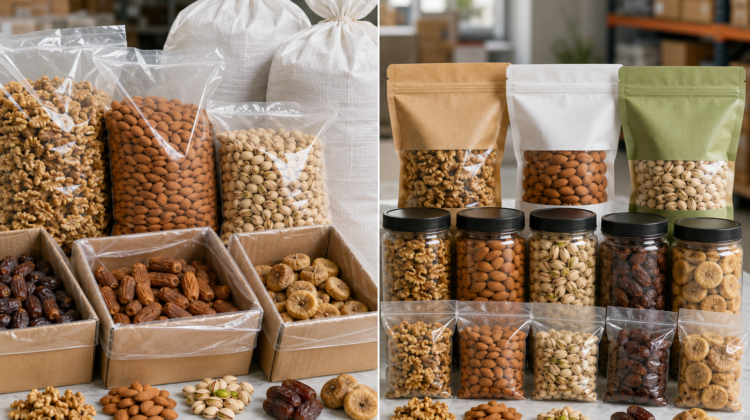
Common bulk packing formats may include:
- Food-grade bags
- Woven outer bags with suitable inner liners
- Lined cartons
- Large foodservice packs
- Bulk boxes
- Sealed commercial pouches
- Other product-specific containers
The correct format depends on the product and its protection requirements.
For example, exposed walnut kernels may require stronger protection from moisture, oxygen, odours and breakage than in-shell walnuts.
Similarly, soft dates may require a different arrangement from dry almonds or pistachios.
What Is Retail Packing?
Retail packing prepares the product for sale to the final consumer.
Common retail formats may include:
- Small pouches
- Resealable bags
- Jars
- Trays
- Boxes
- Gift packs
- Single-serving packs
- Branded containers
- Private-label packs
Retail packing must usually perform several functions at the same time.
It should:
- Protect the product
- Provide required product information
- Support shelf presentation
- Fit the intended portion size
- Remain practical for consumers
- Reflect the brand position
- Meet destination-market requirements
As a result, retail packing usually involves more design, labelling and production decisions than standard bulk packing.
The Main Difference Between Bulk and Retail Packing
The main difference is not only pack size.
Bulk packing supports business operations, while retail packing supports direct consumer sale.
Bulk packing often focuses on:
- Product protection
- Operational efficiency
- Larger quantities
- Handling
- Repacking or processing
- Storage
- Transport efficiency
Retail packing often focuses on:
- Consumer convenience
- Branding
- Shelf appeal
- Portion size
- Product information
- Regulatory labelling
- Retail distribution
Therefore, a buyer should first determine what will happen to the product after delivery.
Will the buyer:
- Repack it?
- Process it?
- Use it as an ingredient?
- Serve it in hospitality?
- Sell it directly to consumers?
The answer helps define the correct packing route.
Bulk Packing for Wholesale Distribution
Wholesale distributors often purchase products in larger commercial packs and then supply them to retailers, foodservice businesses or other buyers.
They may require bulk packing because it can support:
- Larger order volumes
- Warehouse handling
- Cost-efficient distribution
- Repacking
- Customer-specific supply
- Business-to-business sales
However, wholesale buyers still need to confirm:
- Pack weight
- Packing material
- Inner liner
- Outer container
- Lot identification
- Product arrangement
- Storage requirements
- Handling instructions
A general request for “bulk packing” may not provide enough information.
The buyer should explain whether the product will remain in the original pack or be opened and redistributed.
Bulk Packing for Food Manufacturing
Food manufacturers may purchase nuts and dry fruits as ingredients.
Applications may include:
- Bakery products
- Snack bars
- Granola
- Breakfast cereals
- Chocolate
- Confectionery
- Sauces
- Fillings
- Processed foods
Manufacturing buyers may focus on:
- Efficient pack opening
- Product flow
- Piece-size consistency
- Batch identification
- Food-grade contact materials
- Allergen controls
- Storage
- Traceability
- Production scheduling
For example, a bakery may prefer chopped walnut kernels in lined cartons because the product can enter production more easily.
A retail-style pouch may add unnecessary handling, packaging waste and cost in this situation.
Therefore, the packing format should support the buyer’s production process.
Bulk Packing for Hospitality and Foodservice
Hotels, restaurants, catering businesses and other foodservice buyers may require larger packs than ordinary consumers.
They may purchase:
- Walnuts for breakfast service
- Almonds for bakery or garnishing
- Pistachios for desserts
- Dates for hospitality service
- Dry figs for buffets
- Mixed nuts for events
Foodservice packing should support:
- Portion control
- Easy opening
- Repeated use
- Product protection after opening
- Kitchen storage
- Hygiene
- Stock rotation
A large bulk pack may reduce unnecessary individual packaging.
However, the buyer should consider whether staff can safely handle and reseal the pack after opening.
In some operations, several medium-sized foodservice packs may work better than one very large container.
Retail Packing for Direct Consumer Sale
Retail packing places the product in the format consumers see and purchase.
The buyer may need to decide:
- Pack size
- Product weight
- Packaging material
- Closure method
- Transparency
- Branding
- Label design
- Product claims
- Shelf display
- Consumer convenience
For example, a premium walnut-kernel product may use a resealable pouch with a clear viewing window.
A date-gifting range may use a rigid presentation box.
A value-focused almond range may use a simple pouch with practical labelling.
Therefore, retail packing should match the product position and target customer.
Common Retail Pack Sizes
Retail pack sizes vary by product, market and customer.
Possible sizes may include:
- Single-serving packs
- 100-gram packs
- 200-gram packs
- 250-gram packs
- 500-gram packs
- 1-kilogram packs
- Family-size packs
- Gift-box formats
The buyer should not choose a pack size only because it is common elsewhere.
The correct size depends on:
- Consumer habits
- Product value
- Retail price point
- Intended use
- Shelf space
- Product freshness after opening
- Distribution method
For example, a premium product may suit a smaller pack, while a household staple may suit a larger format.
Product Protection Comes First
Packing must protect the food product before it supports branding or appearance.
Nuts, dates and dry fruits may be affected by:
- Moisture
- Oxygen
- Heat
- Light
- Physical damage
- External odours
- Contamination
- Pest exposure
- Unsuitable handling
The importance of each factor depends on the product.
Walnut Kernels
Walnut kernels contain natural oils and may require protection from oxygen, heat, strong odours and breakage.
Almonds
Almonds may require protection from moisture, contamination and physical damage.
Pistachios
Pistachios may require packing that supports product condition and prevents contamination.
Dates
Dates may differ in moisture and texture, so their packing should help manage stickiness, physical pressure and environmental exposure.
Dry Figs
Dry figs may require suitable moisture control and protection from pests, contamination and physical damage.
A visually attractive pack that does not protect the product is not a suitable commercial solution.
Inner and Outer Packing
Commercial packing may involve more than one layer.
Inner Packing
The inner layer directly contacts or closely protects the product.
It may include:
- Food-grade bags
- Liners
- Sealed pouches
- Trays
- Inner wrappers
Outer Packing
The outer layer supports transport, stacking and handling.
It may include:
- Cartons
- Boxes
- Sacks
- Shipping cases
- Pallets
Buyers should confirm both layers.
For example, “packed in cartons” does not explain whether the product has a suitable food-grade inner liner.
Similarly, a strong inner pouch may still require an outer carton for transport protection.
Food-Contact Material
Any material that directly contacts the product should be suitable for its intended food use.
Buyers may need to confirm:
- Material type
- Food-contact suitability
- Intended temperature conditions
- Seal performance
- Product compatibility
- Destination requirements
- Supplier declarations
A packaging material suitable for one product may not automatically suit another.
For example, a dry whole almond product and a soft date product may have different practical packing needs.
Buyers should not select packaging only by colour or appearance.
Standard Packing vs Custom Packing
Standard packing generally uses the supplier’s existing commercial format.
It may offer:
- Faster preparation
- Simpler approvals
- Established materials
- Lower design requirements
- Easier commercial discussion
- Lower minimum quantities in some cases
Custom packing may involve:
- Buyer-selected pack sizes
- Branded artwork
- Printed materials
- Private-label information
- Special pack structures
- Custom cartons
- Product-specific presentation
Custom packing can support branding and retail positioning.
However, it may also require:
- Higher minimum quantities
- Artwork approval
- Material sourcing
- Printing
- Testing
- Additional lead time
- Regulatory review
- Higher development cost
Therefore, buyers should state custom-packing requirements at the beginning of the inquiry.
Private-Label Packing
Private-label packing means that a product appears under the buyer’s own brand or another agreed brand.
A private-label project may require:
- Brand name
- Logo
- Product name
- Ingredient list
- Net weight
- Origin statement
- Allergen information
- Nutrition information
- Storage instructions
- Barcode
- Importer or distributor details
- Manufacturing or packing information
- Date coding
- Language requirements
The exact requirements depend on the product and destination market.
Buyers should not assume that the supplier will create all label content automatically.
Responsibilities for artwork, legal review, translation and regulatory accuracy should receive clear agreement.
Labelling Requirements
Retail food labels may need to include specific information.
Depending on the destination and product, this may include:
- Product name
- Ingredient list
- Net quantity
- Allergen declaration
- Nutrition information
- Country of origin
- Storage instructions
- Best-before or expiry information
- Batch or lot code
- Business details
- Barcode
- Preparation instructions
- Language requirements
Bulk packs may also require labels, but the format and intended audience can differ.
A bulk carton label may focus on:
- Product identification
- Net weight
- Lot number
- Origin
- Packing date
- Storage
- Handling
- Commercial identification
Buyers should confirm the required label content before printing or production begins.
Nutrition Information
Retail packs often require nutrition information.
This data should come from an appropriate and verified source.
Possible sources may include:
- Laboratory analysis
- Approved product data
- Supplier specifications
- Legally permitted reference databases
Businesses should not invent nutritional values or copy them from an unrelated product.
Nutrition can vary according to:
- Variety
- Product format
- Processing
- Added ingredients
- Serving basis
- Moisture
For example, roasted and salted almonds do not necessarily have the same label values as plain natural almonds.
The final label should reflect the actual product.
Allergen Labelling
Walnuts, almonds and pistachios are tree nuts and can cause allergic reactions.
Retail and commercial packing should communicate allergen information clearly.
Buyers may need to confirm:
- Which allergen is present
- Whether the product shares equipment or facilities
- Cross-contact statements
- Destination-market wording
- Ingredient-list presentation
- Label emphasis
A dry fig product may not contain tree nuts, but it may be packed in a facility that handles them.
Therefore, buyers should review supplier allergen information instead of making assumptions.
An attractive pack does not replace accurate allergen communication.
Added Ingredients and Processing Information
Some products may include:
- Salt
- Sugar
- Oil
- Flavouring
- Preservatives
- Sulphites
- Coatings
- Seasonings
- Other ingredients
These additions may affect:
- Ingredient lists
- Allergen declarations
- Nutrition information
- Product naming
- Consumer claims
- Storage
- Shelf life
For example, plain pistachios and salted pistachios require different product descriptions.
Similarly, dry fruit with added sugar differs from an unsweetened product.
The buyer should confirm the exact product before approving packaging or labels.
Bulk Packing and Cost Efficiency
Bulk packing may reduce the amount of packaging used per kilogram of product.
It may also support:
- Faster filling
- Easier warehouse handling
- Lower unit-packing cost
- Reduced individual labelling
- Efficient manufacturing use
- Repacking flexibility
However, bulk packing is not automatically the lowest-cost solution in every situation.
The buyer should also consider:
- Repacking labour
- Repacking equipment
- Additional packaging materials
- Quality controls
- Product loss
- Storage
- Staff handling
- Retail preparation
A buyer without suitable repacking facilities may spend more by purchasing bulk and then outsourcing the retail-packing stage.
Retail Packing and Added Cost
Retail packing may involve additional costs related to:
- Small pack sizes
- Packaging materials
- Printing
- Labels
- Artwork
- Quality checks
- Individual filling
- Sealing
- Date coding
- Cartoning
- Private-label preparation
However, retail packing can also provide value through:
- Consumer convenience
- Brand recognition
- Shelf presentation
- Portion control
- Market readiness
- Reduced buyer-side repacking
Therefore, the buyer should compare total commercial value rather than only the packing price.
Minimum Order Quantities
Custom retail packing often involves minimum order quantities.
These may relate to:
- Printed pouches
- Labels
- Boxes
- Films
- Jars
- Cartons
- Production setup
- Packing-line efficiency
A supplier may have one minimum quantity for the food product and another for the printed packaging.
For example, the product requirement may be commercially possible, but the packaging printer may require a larger quantity of printed pouches.
Buyers should ask:
- What is the minimum order for the product?
- What is the minimum order for custom packaging?
- Can plain packaging with labels support a smaller trial?
- Can unused packaging materials be stored?
- Who owns the remaining printed stock?
These points should receive agreement before production.
Lead Time
Bulk standard packing may require less preparation than custom retail packing.
Custom retail packing may involve:
- Product confirmation
- Pack-size selection
- Material selection
- Artwork preparation
- Regulatory review
- Approval
- Printing
- Packaging delivery
- Filling
- Quality checks
- Final packing
Therefore, buyers should allow sufficient time.
An urgent retail launch may not be realistic when artwork, packaging and approvals have not started.
The buyer should distinguish between:
- Product lead time
- Packaging lead time
- Production lead time
- Shipment timing
- Required arrival date
Storage Efficiency
Pack size affects storage.
Bulk packs may require:
- Larger warehouse spaces
- Pallet handling
- Controlled opening procedures
- Repacking areas
- Stock rotation
- Protection after opening
Retail packs may require:
- More individual units
- More carton space
- Shelf-ready handling
- Barcode control
- SKU management
- Retail inventory planning
The buyer should consider how the packs will move through its own operation.
A 20-kilogram bulk carton may appear efficient, but it may not suit a small hospitality kitchen.
Similarly, small retail packs may create unnecessary complexity for a manufacturing facility.
Transport Efficiency
Packing affects transport volume and weight.
Buyers should consider:
- Pack dimensions
- Carton strength
- Pallet arrangement
- Empty space
- Product density
- Protection
- Container use
- Handling
- Breakage risk
Retail packing may occupy more space per kilogram because of individual packs, labels and presentation materials.
Bulk packing may use space more efficiently, but the product still needs proper protection.
A very thin or weak package may reduce material use but increase product damage.
Therefore, transport efficiency should not compromise food safety or product condition.
Product Breakage
Nuts and dry fruits may experience physical pressure during handling and movement.
Walnut kernels, sliced almonds and other exposed products can break more easily than some whole or in-shell formats.
Packing should consider:
- Product fragility
- Pack weight
- Empty space
- Internal movement
- Carton stacking
- Pallet pressure
- Handling methods
- Transport conditions
A very large bulk pack may increase pressure on delicate products.
In some cases, several smaller bulk packs may protect the product better than one oversized container.
Buyers should define acceptable breakage according to the intended use.
A bakery may accept more pieces than a premium retail brand.
Moisture Management
Nuts and dry fruits respond differently to moisture.
Packing should help protect the product from unsuitable environmental exposure.
Moisture considerations may include:
- Product’s existing moisture level
- Environmental humidity
- Packaging barrier
- Seal integrity
- Storage
- Opening and resealing
- Condensation risks
- Distribution conditions
For example, a resealable retail pouch can support consumer use after opening, but the seal must still perform properly.
A bulk liner may protect the product during shipment, but warehouse staff must close or transfer it appropriately after opening.
Transparent Packaging
Transparent windows or clear containers allow consumers to see the product.
This can support:
- Product visibility
- Consumer confidence
- Premium presentation
- Colour comparison
- Shelf appeal
However, transparency may also increase product exposure to light.
The buyer should consider whether the product benefits from a full barrier, partial window or opaque pack.
The decision should balance:
- Product protection
- Shelf appearance
- Consumer expectations
- Storage conditions
- Retail environment
Resealable Packaging
Resealable packs may improve convenience for products that consumers use over several occasions.
They may suit:
- Nuts
- Dry fruits
- Snack mixes
- Family-size packs
- Breakfast ingredients
However, a resealable feature does not guarantee that the consumer will close the package correctly.
The original pack should still provide suitable protection before opening.
The label may also need storage instructions such as keeping the product sealed and stored in a suitable environment.
Gift Packaging
Dates, nuts and dry fruits often appear in gift assortments.
Gift packing may involve:
- Decorative boxes
- Compartments
- Trays
- Premium finishes
- Ribbons
- Sleeves
- Custom inserts
- Mixed-product arrangements
Gift packaging should still consider:
- Food-contact safety
- Product separation
- Allergen information
- Net quantities
- Product protection
- Storage
- Labelling
- Transport
A beautiful box that allows products to move, mix or become damaged is not an effective solution.
Buyers should test the complete pack through handling and transport conditions.
Mixed Nut and Dry Fruit Packs
Mixed packs may contain products with different:
- Moisture levels
- Textures
- Allergens
- Sizes
- Shelf-life behaviour
- Physical properties
For example, soft dates packed with dry almonds may create a different moisture interaction than almonds packed alone.
The business should evaluate:
- Ingredient compatibility
- Moisture transfer
- Product separation
- Allergen declaration
- Piece distribution
- Pack appearance
- Shelf life
A mixed pack should receive complete product testing rather than relying on the individual shelf life of each ingredient.
Sustainability Considerations
Packing decisions may also include environmental considerations.
Buyers may evaluate:
- Material quantity
- Recyclability
- Reusability
- Pack weight
- Transport efficiency
- Product waste
- Food protection
- Local disposal systems
However, less packaging is not automatically more sustainable when it increases food damage or spoilage.
The first responsibility of food packaging is to protect the product safely.
A responsible approach balances:
- Product protection
- Material use
- Operational efficiency
- Transport
- Consumer use
- Waste management
Businesses should avoid unsupported claims such as “zero-impact packaging” or “completely eco-friendly.”
Branding Considerations
Retail packaging communicates the brand to consumers.
The buyer may need to define:
- Brand position
- Target customer
- Product range
- Visual identity
- Pack hierarchy
- Claims
- Product story
- Origin communication
- Language
- Retail price point
A premium product may use a different visual approach from a value-focused wholesale range.
However, branding should not hide essential product information.
The label should remain readable, accurate and compliant.
Bulk Packs Still Need Identification
Bulk packs may not require the same consumer-facing design as retail packs.
However, they still need clear identification.
A bulk pack label may include:
- Product name
- Product format
- Net weight
- Batch or lot number
- Origin
- Packing date
- Best-before information
- Storage instructions
- Allergen information
- Supplier or packer details
This information supports:
- Warehouse handling
- Traceability
- Production control
- Stock rotation
- Quality investigations
Plain outer cartons without clear product identification can create operational risks.
Quality Checks During Packing
Businesses should control packing quality.
Possible checks include:
- Correct product
- Correct pack size
- Correct net weight
- Seal integrity
- Label accuracy
- Batch coding
- Product appearance
- Pack cleanliness
- Carton strength
- Pallet stability
Retail-packing projects may also require:
- Barcode testing
- Artwork verification
- Language review
- Print-quality review
- Shelf-display checks
A packing error can affect many individual units.
Therefore, approvals and controls should occur before full production.
Buyer Approval Process
Custom retail packing often requires formal buyer approval.
The approval process may include:
- Product specification approval
- Pack-size approval
- Material approval
- Artwork draft
- Regulatory review
- Physical sample
- Colour approval
- Final production approval
Buyers should record approvals in writing.
Verbal approval may create confusion if artwork or product details later change.
The parties should also define who is responsible for legal label accuracy.
Questions Buyers Should Ask About Bulk Packing
Bulk buyers may ask:
- What standard pack sizes are available?
- Which inner liner is used?
- What outer carton or bag applies?
- Is the packing suitable for the product format?
- How is the pack sealed?
- What lot information appears?
- What storage guidance applies?
- How should the product be handled after opening?
- What documentation accompanies the shipment?
- Can the product support our repacking or production process?
Questions Buyers Should Ask About Retail Packing
Retail buyers may ask:
- Which pack sizes can be considered?
- What packaging materials are available?
- What minimum quantities apply?
- Can custom branding be added?
- Who prepares the artwork?
- Who verifies the label?
- What printing lead time applies?
- Can a physical sample be approved?
- What date-coding method is used?
- How is the product packed for transport?
- Which destination-market requirements must be confirmed?
How to Prepare a Bulk Packing Inquiry
A useful inquiry may say:
We require walnut kernel pieces for bakery production. The estimated quantity is five metric tonnes. Please advise regarding available standard bulk pack sizes, inner liners, carton specifications and storage guidance for delivery to our destination.
This inquiry explains:
- Product
- Format
- Intended use
- Quantity
- Packing requirement
- Destination context
It gives the supplier a stronger basis for discussion.
How to Prepare a Retail Packing Inquiry
A useful retail inquiry may say:
We require whole natural almonds for a private-label retail range. The proposed pack size is 250 grams, with an estimated initial quantity of 10,000 packs. Please advise regarding packaging options, minimum quantities, artwork requirements, labelling information and production lead time.
This inquiry explains:
- Product
- Intended market
- Pack size
- Approximate volume
- Private-label requirement
- Required information
Bulk and Retail Packing Comparison
Bulk Packing May Suit
- Food manufacturers
- Bakeries
- Wholesalers
- Repackers
- Hospitality
- Ingredient buyers
- Large-volume distributors
Retail Packing May Suit
- Supermarkets
- Consumer brands
- E-commerce retailers
- Specialty shops
- Gift businesses
- Direct-to-consumer sellers
- Private-label programmes
Bulk Packing Usually Prioritises
- Operational efficiency
- Product protection
- Larger pack sizes
- Warehouse handling
- Processing
- Repacking
Retail Packing Usually Prioritises
- Consumer convenience
- Branding
- Labelling
- Shelf presentation
- Portion size
- Market readiness
Common Packing Mistakes
Buyers should avoid several common mistakes.
Selecting Packing Only by Price
The pack must protect the product and support the intended operation.
Requesting Custom Packing Too Late
Artwork, printing and material preparation require time.
Ignoring Minimum Quantities
Custom printed packaging may have separate minimum-order requirements.
Using Incorrect Label Information
Product, ingredient, nutrition and allergen information must match the actual product.
Choosing a Pack Size Without Market Research
Consumer habits and price positioning influence pack-size suitability.
Assuming One Pack Works for Every Product
Dates, walnut kernels and almonds may require different practical solutions.
Ignoring Product Breakage
Pack weight and internal movement can affect fragile products.
Treating Sustainability as Only Material Reduction
Food protection and product waste also matter.
Forgetting Buyer-Side Storage
The receiving business must have suitable space and handling systems.
Approving Artwork Without Regulatory Review
A visually attractive label may still contain inaccurate or incomplete information.
How Maahir International Supports Packing Discussions
Maahir International supports B2B food-trade conversations involving nuts, dates, dry fruits and selected food ingredients.
For packing requirements, buyers should share:
- Product category
- Product format
- Intended use
- Approximate quantity
- Bulk or retail requirement
- Preferred pack size
- Branding requirement
- Destination market
- Required documentation
- Expected timeline
This information helps structure a clearer discussion around product suitability, packing scope and the next commercial step.
Custom packing, private-label preparation and destination-specific labelling should receive confirmation for the exact product and order.
Choosing the Right Packing Route
Bulk packing and retail packing solve different commercial needs.
Bulk packing can support efficient wholesale, manufacturing, hospitality and repacking operations.
Retail packing can prepare products for consumer sale through smaller sizes, branding, labels and shelf-ready presentation.
The correct choice depends on:
- Product type
- Product format
- Intended use
- Quantity
- Distribution method
- Consumer needs
- Packing budget
- Storage
- Destination
- Required timing
Buyers should compare the complete operational requirement instead of focusing only on the initial packing cost.
Start a Packing Conversation
Businesses interested in bulk or retail packing for walnuts, almonds, pistachios, dates, dry figs or selected food ingredients should prepare a clear requirement.
Share the product, format, approximate quantity, intended use, preferred pack size, branding requirements, destination and expected timeline with Maahir International.